


Key Takeaways:
- Most players either skip their warm-up or spend too much time doing the wrong things before a match.
- A targeted 5-minute warm-up can improve power, coordination, reaction speed, and movement efficiency.
- Dynamic movement and reactive drills prepare your body for pickleball far better than passive stretching.
- Focus on body temperature, joint mobility, movement patterns, reactivity, and speed to feel sharp from the first point.
Most pickleball players step on the court either underprepared or overdoing it. The biggest benefit of a solid warm-up is preparing the systems you actually use in the first few points: movement, timing, and reaction.
A short, targeted warm-up can improve power output, coordination, and reaction speed by increasing muscle temperature, enhancing nerve conduction, and improving joint stiffness and elasticity (1).
And you don’t need to perform a long passive stretch routine to start feeling loose. Dynamic movement, rather than static stretching, is consistently shown to support better performance in explosive and reactive sports (2).
The goal is simple: feel fast, connected, and ready to react from the first rally.
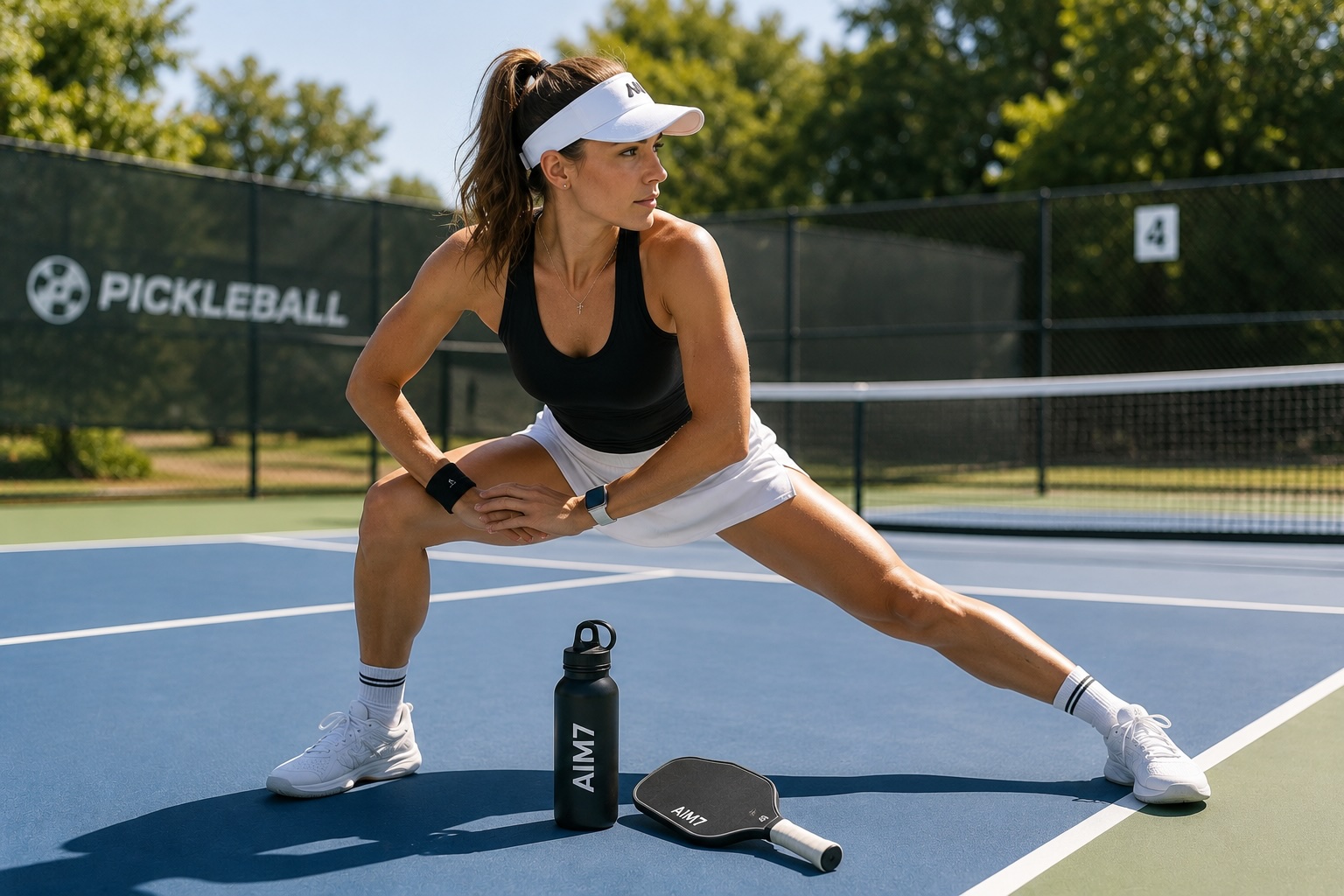
A 5-Minute Warm-Up That Transfers to Your Game
Minute 1: Get your body temperature up
- Light jog, shuffle, or jump rope
- Keep it easy but continuous
Minute 2: Open up key joints
- Focus on the areas you rely on most:
- Hip openers (leg swings or lunges with rotation)
- Ankle rocks or calf pulses
- Torso rotations
Minute 3: Activate movement patterns
- Now start layering in intent:
- Lateral shuffles
- Split-step into short accelerations
- Quick deceleration and re-acceleration
Minute 4: Introduce reactivity
- Pickleball is reactive, so your warm-up should be too:
- Partner ball drops or hand toss reactions
- Quick volley exchanges at the net
- Short court movements with directional changes
Minute 5: Prime for speed
- You should walk into your first point feeling quick, not fatigued.
- 2–3 short, sharp accelerations
- One or two fast split-step + first-step reactions
- Keep volume low, intensity high
Common Mistakes
- Static stretching right before play: may temporarily reduce power output
- Too much volume: long warm-ups can leave you flat
- Skipping reactivity: hitting a few easy dinks doesn’t prepare your nervous system
Bottom line
A short, targeted warm-up can set the tone for your entire match. Focus on elevating your body temperature and prioritizing movement, reactivity, and speed so your first game doesn’t feel like your warm-up.
References
- Bishop D. Warm up II: performance changes following active warm up and how to structure the warm up. Sports Med. 2003;33(7):483-498. doi:10.2165/00007256-200333070-00002
- Behm DG, Chaouachi A. A review of the acute effects of static and dynamic stretching on performance. Eur J Appl Physiol. 2011;111(11):2633-2651. doi:10.1007/s00421-011-1879-2


